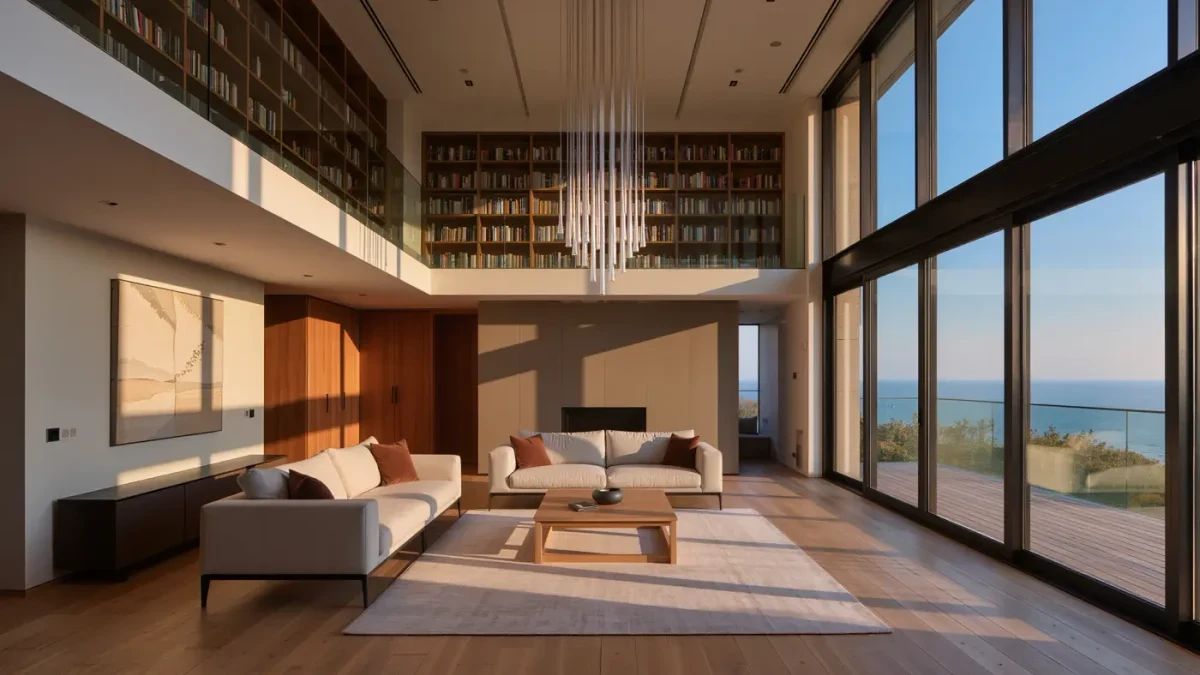
A double-height room — a living volume rising two stories, usually glazed at height — has become one of the most requested features in new residential construction and conversions, appearing in developer plans from loft conversions to purpose-built towers; the type's lineage runs from the galleried halls of Victorian houses, through modernism's double-height living rooms (Le Corbusier's 1920s villas made the void a spatial instrument), to the 1980s American foyer-with-chandelier, and back to fashion today. The revival is not nostalgia. The double height delivers two things buyers consistently pay for — light that reaches deep into a plan, and a room that photographs as an event.
What the feature costs, and what it quietly bills back, is the honest story.
Why do double-height rooms work so well?
Physics first: a tall window lights a room roughly twice as deep as a standard one — daylight penetrates a space to about two to two-and-a-half times window-head height, so a 20-foot head lights a 45-foot-deep floor plate where an 8-foot head lights 18. In apartments and narrow row plans, the double height is the difference between a bright plan and a cave with a lamp. Psychology second: vertical volume reads as importance — the cathedrals knew, and so does every hotel lobby; the double-height living room borrows the same awe at domestic scale. Practicality third: the void enables real mezzanines — a sleeping loft or study overlooking the living space — adding usable square footage without adding footprint, the feature's quiet economic engine.
What are the costs?
- Heating the void: warm air stratifies upward — the comfortable zone and the thermostat disagree in a 20-foot room; ceiling fans and high-return ducts are the standard correctives, and modern double-height designs detail them in.
- Cleaning and maintenance: the 20-foot window that makes the room needs washing; the second-floor chandelier needs a scaffold. Budget the feature's accessories.
- Acoustics: hard double-height volumes echo — the vertical living room amplifies television, conversation, and the mezzanine sleeper's alarm clock; soft goods, drapery, and rug coverage are not optional decor but acoustic infrastructure.
- Code and safety: guardrails at mezzanine edges, window-washing access, and (in renovations) egress from the loft level all have requirements — the feature's romance is engineering-reviewed.
Related stories: Courtyard apartments: the quiet alternative to the tower · Why glass block keeps coming back.
Where did the type come from, briefly?
Victorian townhouses used the double-height parlor (and stair hall) as status theater. Modernism — from Le Corbusier's Villa La Roche to countless mid-century case-study houses — used it as spatial poetry, the void as sculpture. American production housing of the 1980s cheapened it into the two-story entrance foyer: a void no one lived in, heating the mailbox. The current revival corrected that lesson: today's double heights wrap the living space itself — the room people occupy — with the mezzanine as the bonus, which is why the feature finally earns its energy bill.
What should a buyer check?
- Orientation of the tall glazing: a south- or west-facing double height can overheat without external shading; ask how summer sun is handled.
- Acoustic treatment: stand in the mezzanine while someone talks below — the echo you hear at the viewing is the echo you will live with.
- HVAC detailing: ask where the returns are; a high return and a destratification fan indicate the builder understood the room.
- Guard and rail design at height: both safety and sightline — a mezzanine rail you can see through keeps the volume feeling whole.
- Window access: who cleans it, from what, and at what cost — the taller the glass, the more this line matters.
FAQ
What is a double-height living room?
A living space rising two stories, usually with tall glazing and often a mezzanine loft. The height delivers roughly twice the daylight depth of a standard room and a sense of volume that reads as luxury at domestic scale — the two things buyers most consistently pay premiums for.